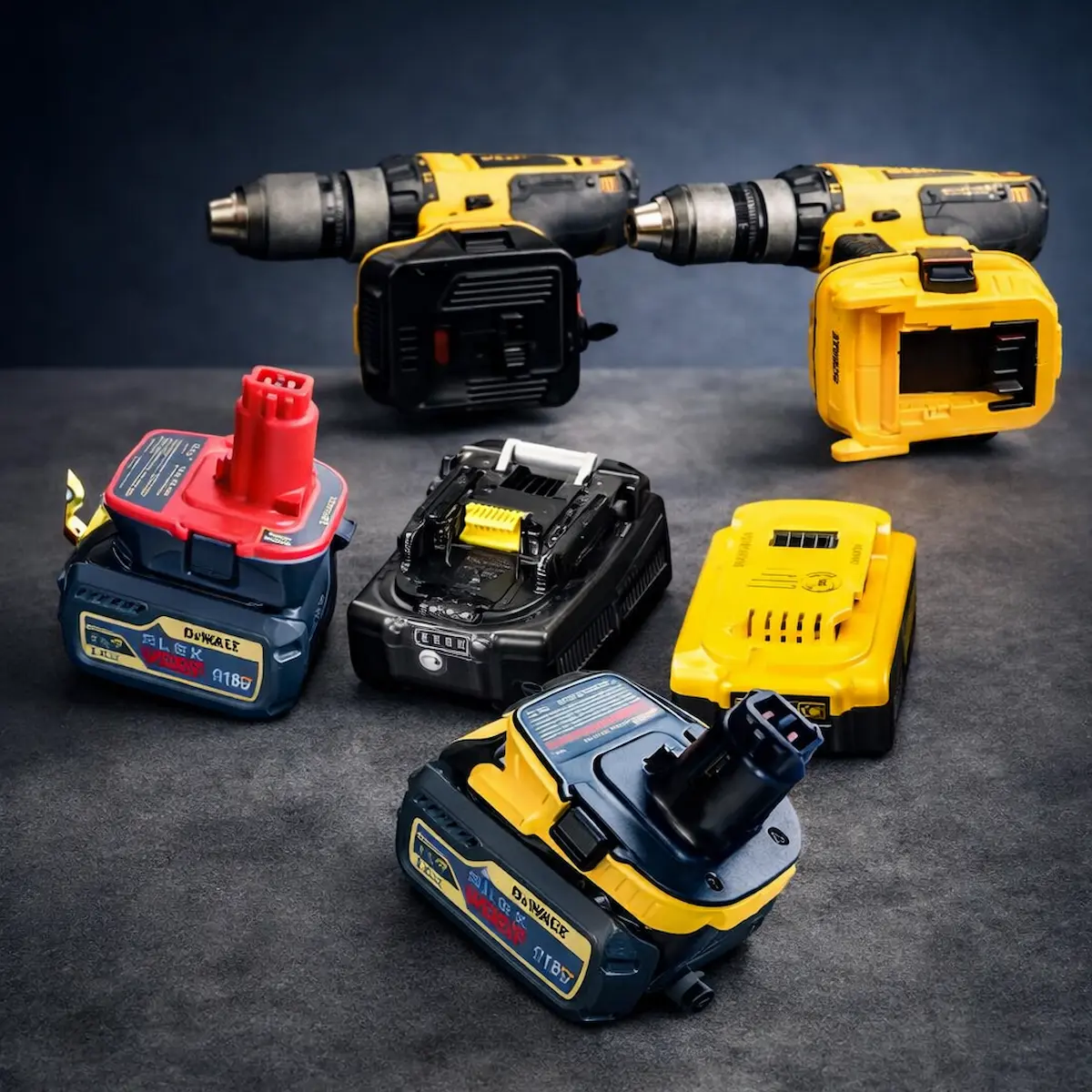
Power tools have evolved dramatically over the last two decades, and one of the biggest reasons is the advancement of battery technology. Whether you’re a contractor in the USA working on large residential builds, a tradesperson in Australia handling outdoor construction, or a small contractor in the UK or Asia managing renovation projects, the type of battery inside your tools directly affects performance, runtime, safety, and long‑term cost.
Understanding the differences between lithium‑ion, NiCd, NiMH, lead‑acid, alkaline, and LiFePO4 batteries helps contractors choose the right power source for their tools and working conditions.
This guide breaks down the “what, why, when, where, how, and which” of modern battery technology with a focus on real‑world usage in construction and trade environments.
-
What Are Lithium‑Ion Batteries?
Lithium‑ion (Li‑ion) batteries are the dominant power source for modern cordless tools. They use lithium compounds to store energy, allowing them to deliver high power in a compact, lightweight form. Compared to older battery technologies, lithium‑ion batteries offer:
- High energy density – more power in a smaller size
- Lightweight design – reduces fatigue during long workdays
- Fast charging – minimizes downtime on job sites
- Long cycle life – lasts through hundreds of charge cycles
- Low self‑discharge – holds charge when stored
For contractors in the USA and Australia, where cordless tools are widely used for framing, roofing, electrical work, and general construction, lithium‑ion batteries have become the standard. In the UK and Asia, where job sites often vary in size and power availability, lithium‑ion tools offer flexibility and mobility that corded tools cannot match.
-
Other Battery Types Used in Tools and Equipment
While lithium‑ion batteries dominate today’s power‑tool market, other battery types still exist in certain tools, equipment, and older models. Understanding their characteristics helps contractors make informed decisions.
NiCd (Nickel‑Cadmium)
- Heavy compared to modern batteries
- Known for the memory effect, which reduces capacity if not fully discharged
- Performs well in extreme cold, making it useful in certain climates
- Durable but environmentally hazardous due to cadmium content
NiCd batteries were once the standard in power tools but are now largely outdated.
NiMH (Nickel‑Metal Hydride)
- Higher capacity than NiCd
- Less toxic and more environmentally friendly
- Still heavier and bulkier than lithium‑ion
- Moderate self‑discharge rate
NiMH batteries are sometimes found in budget tools or older models.
Lead‑Acid
- Used in large equipment, generators, and backup power systems
- Very heavy and bulky
- Long lifespan but not suitable for handheld tools
Lead‑acid batteries are common in industrial settings but not in portable power tools.
Alkaline
- Disposable, inexpensive
- Not rechargeable
- Not suitable for power tools due to low current output
Alkaline batteries are used in flashlights, remotes, and small devices not drills or saws.
LiFePO4 (Lithium Iron Phosphate)
- Safer chemistry with lower risk of overheating
- Very long lifespan
- Lower energy density than lithium‑ion
- Common in solar storage, backup systems, and some heavy‑duty equipment
LiFePO4 is gaining popularity in Asia and Australia for off‑grid power and renewable‑energy systems.
-
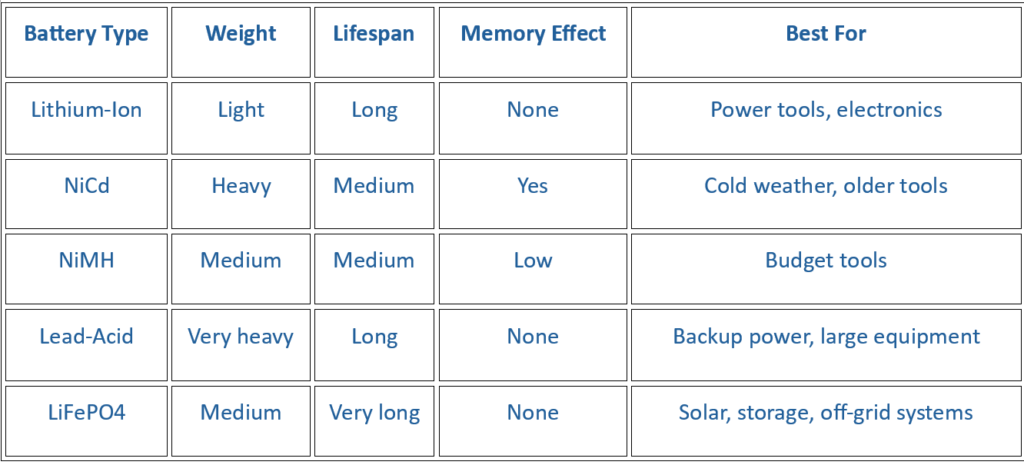
Comparison Table – Battery Types at a Glance
-
Why Lithium‑Ion Is Preferred in Modern Power Tools
Lithium‑ion batteries dominate the USA, Australia, UK, and Asian power‑tool markets for several reasons:
Lightweight and Compact
Contractors spend hours holding drills, saws, and grinders. A lighter battery reduces fatigue and improves control.
High Power Output
Lithium‑ion batteries deliver strong, consistent power – essential for cutting, drilling, grinding, and fastening.
No Memory Effect
Unlike NiCd batteries, lithium‑ion batteries do not require full discharge cycles. Contractors can charge them anytime without reducing capacity.
Fast Charging
Modern chargers can bring a lithium‑ion battery to 80% in under 30 minutes, keeping workflow smooth.
Long Cycle Life
A well‑maintained lithium‑ion battery can last several years, even with daily use.
Better Performance in Professional Tools
Brands like DeWalt, Milwaukee, Makita, Bosch, and HiKOKI design their flagship tools around lithium‑ion platforms.
-
When to Use Which Battery Type
Different job conditions call for different battery technologies.
Use Lithium‑Ion When:
- You need high power for drills, saws, grinders, and impact drivers
- You want lightweight tools for long work sessions
- You need fast charging and minimal downtime
- You work in the USA, Australia, UK, or Asia where cordless tools are common
Use NiCd When:
- You work in extreme cold where lithium‑ion performance drops
- You use older tools that still rely on NiCd packs
Use LiFePO4 When:
- You need long‑term storage power
- You work with solar systems, backup power, or off‑grid setups
- You need a safer, stable battery for stationary equipment
-
Where Lithium‑Ion Batteries Are Used Today
Lithium‑ion batteries power far more than just drills and saws. Their versatility makes them the preferred choice across industries.
Common Applications
- Power tools – drills, impact drivers, saws, grinders
- Laptops and electronics
- Electric vehicles
- Solar storage systems
- Drones and robotics
- Portable lighting and job‑site equipment
In the USA and Australia, lithium‑ion tools dominate construction and trade industries. In the UK and Asia, where contractors often work in tight spaces or move between multiple small job sites, lithium‑ion’s portability is a major advantage.
-
How to Extend Battery Life
Proper care can significantly extend the lifespan of lithium‑ion and other battery types.
Battery Care Tips
- Avoid full discharge – keep lithium‑ion batteries above 20%
- Store at 40–60% charge when not in use
- Keep batteries cool – heat shortens lifespan
- Clean battery contacts to maintain good electrical connection
- Use the correct charger recommended by the manufacturer
- Avoid leaving batteries on chargers overnight
Good battery maintenance saves money and improves tool performance.
-
Safety Considerations for All Battery Types
Battery safety is essential on job sites, especially in hot climates like Australia or humid regions in Asia.
Safety Guidelines
- Stop using swollen or damaged batteries
- Use only approved chargers
- Do not charge batteries in extreme heat
- Keep batteries away from flammable materials
- Replace batteries that overheat during use
- Store batteries in a cool, dry place
Lithium‑ion batteries are safe when used correctly, but like all high‑energy devices, they require proper handling.
-
Future Battery Technologies to Watch
Battery technology continues to evolve, and several emerging technologies may shape the future of power tools.
Solid‑State Batteries
- Higher energy density
- Improved safety
- Potential for longer runtimes
Graphene Batteries
- Extremely fast charging
- High conductivity
- Still in early development
Sodium‑Ion Batteries
- Lower cost
- Abundant materials
- Lower energy density than lithium‑ion
These technologies may eventually appear in power tools, electric vehicles, and renewable‑energy systems.
Conclusion
Lithium‑ion batteries have transformed the power‑tool industry across the USA, Australia, the UK, and Asia. Their combination of lightweight design, high power output, fast charging, and long lifespan makes them the ideal choice for modern contractors. While older battery types like NiCd and NiMH still exist, and specialized batteries like LiFePO4 serve niche roles, lithium‑ion remains the most versatile and efficient option for everyday construction and trade work.
Understanding the strengths and limitations of each battery type helps contractors choose the right tools, maintain them properly, and work more efficiently across a wide range of job conditions.
Next Recommended Article
References
- International Electrotechnical Commission (IEC) : IEC 62133 & IEC 62619 battery safety standards
- U.S. Department of Energy (DOE) : Energy Storage & Lithium-Ion Battery Research Programs
- Bosch Professional Power Tools (manufacturer reference): Bosch Professional battery technology & safety documentation
Sources & Further Reading
- ToolTested – Battery Types and Power Tool Performance
- Pro Tool Reviews – Lithium‑Ion vs NiCd vs NiMH
- A‑Class Pro Tools AU – Battery Technology in Modern Tools
Editorial Disclaimer
This content is for educational purposes only. Always follow manufacturer guidance and safety procedures.