
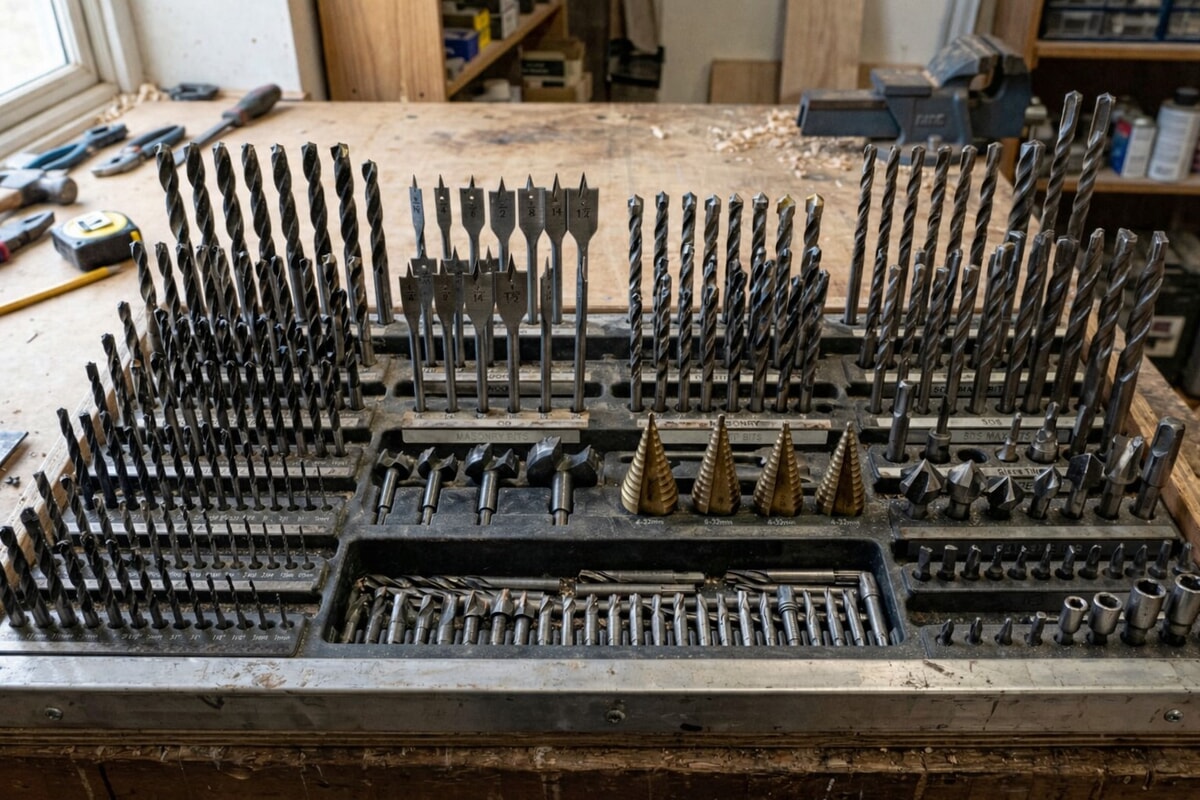
Drill bit types explained simply is not just a beginner topic it is a real productivity and cost-control issue in workshops, job sites, and maintenance teams across the USA, Australia, and New Zealand. One wrong bit choice can lead to slow drilling, poor hole quality, broken tools, overheated material, and extra labor. In procurement and tool supply, the most consistent wins come from matching bit geometry, material, and coating to the workpiece then standardizing the best options so technicians are not forced to “make do” with whatever is in the drawer.
This guide breaks down common drill bit types, what each one is designed to do, and how to choose them for wood, metal, masonry, plastics, and composites. It also covers what tends to vary between North American, European, and Asian manufacturing supply chains useful when comparing brands, private-label products, and specification sheets.
1) The basics: what makes one drill bit different from another :
Most drill bits are defined by a few core features:
- Point design (tip geometry): affects how the bit starts, how much it “walks,” and how it handles different materials.
- Flutes: carry chips out of the hole; flute shape influences chip evacuation.
- Cutting edge material: HSS, cobalt HSS, carbide, or carbide-tipped.
- Coating: reduces friction, improves heat resistance, or improves wear.
- Shank style: straight, hex, reduced shank, SDS, etc., which affects chuck compatibility and power transfer.
A good selection strategy starts with material type (wood/metal/masonry), then drilling method (hand drill, drill press, hammer drill, rotary hammer, CNC), then hole size and depth, then finish requirements.
2) Twist drill bits (the “standard” bit for metal and general use)
What they are: The most common bit style. Twist drills are used for mild steel, stainless (with correct grade), aluminum, plastics, and general-purpose drilling.
Typical materials:
- HSS (High Speed Steel): general-purpose, good value.
- Cobalt HSS (often M35/M42): higher heat resistance for tougher steels and stainless.
- Carbide (solid or tipped): used in production, rigid setups, or abrasive materials.
Point types you will see:
- 118° point: common general-purpose point; may wander more on metal unless center-punched.
- 135° split point: starts more easily and reduces walking; popular for metalwork and maintenance.
When they shine: Mixed-material environments, tool cribs, maintenance kits, and general shop use.
Common buying notes (USA/AU/NZ):
- For maintenance and fabrication teams, 135° split point HSS is often a strong baseline.
- For stainless-heavy work, cobalt tends to reduce burn-out and dulling, provided feeds/speeds are controlled.
3) Brad point bits (clean holes in wood)
What they are: Wood bits with a sharp center point and spurs that score the outer edge.
Best for: Softwood, hardwood, plywood especially where tear-out matters (cabinetry, trim, furniture).
Pros:
- Starts accurately with less wandering.
- Cleaner hole edges than twist drills in wood.
Cons:
- Not designed for metal.
- Can be damaged by nails or hidden fasteners.
Procurement tip: For carpentry-focused kits, brad points reduce rework because hole entry is cleaner and more precise.
4) Spade (paddle) bits (fast, rough holes in wood)
What they are: Flat paddle-style bits for larger holes.
Best for: Electrical and plumbing rough-ins, framing, general construction where speed matters more than finish.
Pros: Fast and affordable for wood.
Cons:
Rougher hole quality and more tear-out.
Requires good control; can grab when breaking through.
Selection tip: Consider spade bits with spur points or improved edge geometry for cleaner results, especially in visible work.
5) Auger bits (deep, clean holes in wood)
What they are: Wood drilling bits with a screw tip that pulls the bit through, plus deep flutes.
Best for: Deep holes in timber, beams, and structural wood.
Pros: Excellent chip evacuation and depth capability.
Cons: The screw tip is aggressive needs a controlled drill with proper torque.
Field note: In AU/NZ timber work and rural maintenance, augers are common due to frequent drilling in thick wood sections.
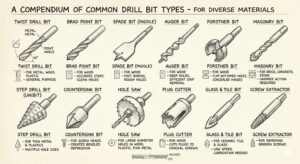
6) Forstner bits (flat-bottom holes in wood)
What they are: Precision woodworking bits designed to cut clean, flat-bottomed holes.
Best for: Hinge cups (e.g., cabinet hinges), dowel holes, and clean overlapping holes.
Pros:
- Very clean edges.
- Flat-bottom holes.
Cons:
- Slower than spade/brad point.
- Usually better in a drill press than handheld for accuracy.
Buying tip: Forstners vary widely in quality. Consistent rim sharpness matters more than packaging claims.
7) Hole saws (large diameter holes in many materials)
What they are: A ring-shaped saw with teeth around the edge, usually used with an arbor and pilot drill.
Best for: Larger holes in wood, drywall, plastics, and thin metals (with correct tooth design).
Pros: Efficient for large diameters without removing all material.
Cons:
- Can bind if chips are not cleared.
- Heat management matters in metal.
Use cases: Door hardware, plumbing penetrations, electrical conduit holes, HVAC work.
Procurement note: Keeping replacement pilot drills and arbors in stock prevents downtime these are small parts that often go missing.
8) Step drill bits (clean holes in thin metal and plastics)
What they are: Conical bits with “steps” for gradually enlarging holes.
Best for: Sheet metal, electrical panels, enclosures, and plastic sheet.
Pros:
- Excellent control in thin materials.
- Clean holes with less grabbing than large twist drills.
- One bit can cover multiple sizes.
Cons: Not ideal for thick stock; can be expensive.
Buying tip: For maintenance teams working with panels and enclosures, step bits often reduce burrs and rework time especially compared to standard drills that catch and distort thin sheet.
9) Masonry drill bits (concrete, brick, block)
What they are: Typically carbide-tipped bits designed for abrasive mineral materials.
Two main use categories:
- For hammer drills (standard chuck): for light to medium masonry work.
- For rotary hammers (SDS): for heavier drilling in concrete and reinforced structures.
Pros: Carbide tips resist abrasion.
Cons:
- Inappropriate use on steel/wood leads to rapid dulling.
- Performance depends heavily on tool type (hammer drill vs rotary hammer).
Regional note: In Europe, SDS systems are widely standardized and common on construction sites; the same trend is strong in AU/NZ and increasingly common in the USA.
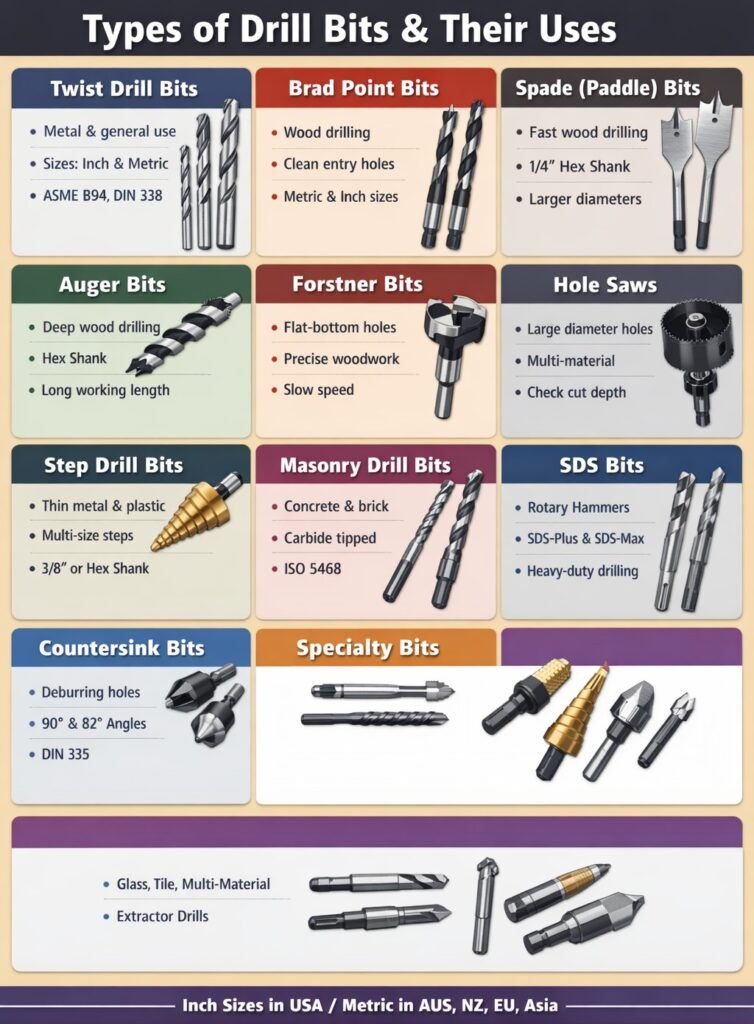
10) SDS bits (SDS-Plus, SDS-Max) for rotary hammers
What they are: Bits with slotted shanks that lock into a rotary hammer, allowing hammer energy transfer efficiently.
Best for: Concrete drilling, anchors, rebar-aware drilling (with proper bit type), and heavy-duty site work.
Pros: Faster drilling and lower operator fatigue than standard hammer drill setups.
Cons: Requires compatible tools; not interchangeable with standard chucks without adapters (and adapters reduce performance).
Procurement tip: Standardize SDS type by site/team (Plus vs Max) to avoid mismatched inventory.
11) Countersink and deburring bits (finishing accessories)
What they are: Tools to create chamfers for screw heads and remove sharp edges.
Best for: Wood and metal finishing, assembly work.
Why they matter: A drilled hole often needs secondary finishing especially in metalwork where burrs affect fit and safety.
Buying tip: Treat these as part of a drilling system, not an afterthought. A small countersink inventory can significantly improve assembly quality.
12) Specialty drill bits (common in industry and MRO)
Depending on the sector, these are frequently requested:
- Left-hand drill bits: used in repair work and fastener extraction scenarios.
- Center drills / spotting drills: used to start holes accurately in metal and reduce wandering (more common in machine shops).
- Tile and glass bits: spear-point carbide or diamond-coated styles for brittle surfaces.
- PCB/micro bits: small diameters for electronics and precision work.
- Core bits (diamond core): for large holes in concrete/stone with water management.
13) Drill bit coatings and finishes (what they really do)
Common coatings include:
- Black oxide: modest improvement in corrosion resistance and chip flow; often used on HSS.
- TiN (Titanium Nitride): reduces friction; helps in many metals but has temperature limits.
- TiAlN/AlTiN: better high-temperature performance; common in production drilling.
- Diamond coatings: niche use for abrasive non-metals and composites.
Practical note: Coatings help, but they do not compensate for poor speeds/feeds, dull edges, or incorrect bit type.
14) How to choose the right bit (a simple decision framework)
- Material: wood, metal (mild/stainless/aluminum), masonry, plastic, composite
- Thickness and depth: thin sheet vs thick stock vs deep holes
- Tool type: cordless drill, drill press, hammer drill, rotary hammer
- Hole quality needs: clean edge, flat bottom, accurate size, minimal burr
- Production level: occasional use vs repetitive drilling (tool life matters more)
Quick examples:
- Thin stainless panel: step bit or quality split-point cobalt (with correct technique)
- Cabinet hinge holes: Forstner bit
- Deep timber hole: auger
- Concrete anchors: SDS-Plus bit in a rotary hammer
- General metal maintenance: 135° split-point HSS set, plus cobalt sizes for tougher steels
15) Sourcing and quality: USA/AU/NZ buyers comparing Europe and Asia
In procurement, the same claims appear on many listings, but supply chains differ:
- European suppliers often provide strong documentation, consistent geometry, and stable lot-to-lot quality especially in professional ranges.
- Asian manufacturing covers everything from entry-level to high-end OEM production. Many reputable global brands also manufacture in Asia under strict quality systems. The key is verifying specification control, not judging by origin alone.
- For USA, Australia, and New Zealand, a balanced strategy is common:
- stock a reliable “standard” set for general work,
- add higher-grade bits (cobalt, premium step bits, SDS) where downtime and rework cost more than the tool.
Quality indicators that matter more than marketing:
- Consistent point geometry (especially split points)
- Good grinding finish on flutes
- Accurate diameter and roundness
- Clear material spec (HSS vs cobalt grade)
- Packaging that protects cutting edges (prevents damage in storage)
16) Additional valuable tip: standardize by application, not by brand
Shops that reduce drill bit spend typically do three things:
- define a short approved list of bit types by task (metal/wood/masonry/panels),
- keep those in consistent sizes and shank styles,
- train teams to stop using the wrong bit “because it’s available.”
This reduces breakage, improves hole quality, and makes inventory predictable.
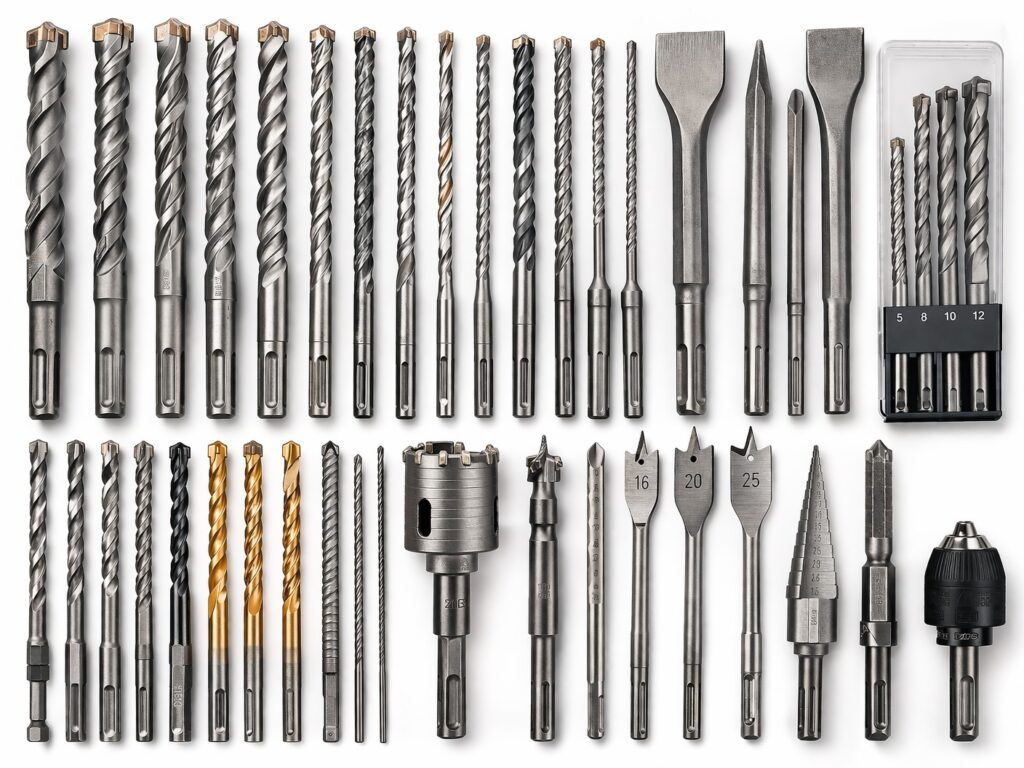
Choosing the Correct Drill Bit: Materials, Sizes, and Applications
Twist Drill Bits (Standard Bit for Metal and General Use)
- Diameter (Size): Commonly ranges from 1.5 mm to 13 mm (1/16″ to 1/2″ fractional). Larger sizes are available for industrial chucks.
- Length: Available in stub (short), jobber (standard), and taper length or aircraft (long/extra-long).
- Hole Depth Match: Depth is strictly limited by the flute length; clearing chips frequently is required for depths exceeding three times the diameter.
- Fit: Features round or reduced flat-sided shanks to fit standard 3-jaw chucks.
- Drill Suitability: Ideal for corded and cordless rotary drills. Not suitable for hammer action unless the bit is specifically designated as a masonry twist bit.
- Material Suitability: General use; cuts softwood, hardwood, metal, and plastic. Not for masonry.
- Tough Materials: Standard High-Speed Steel (HSS) handles mild steel. Cobalt alloy twist bits are required for stainless steel or cast iron.
- Coating: Frequently coated with titanium nitride (TiN) for heat resistance, black oxide for corrosion resistance, or made from cobalt alloys.
- Tip Type: Typically features a 118-degree standard tip or a 135-degree split-point (self-centering) tip.
- Cutting Speed: Moderate to fast cutting action.
- Hole Finish: Moderate; provides a clean entry but may cause splintering upon exit in wood.
- Life: High lifespan when used with correct speeds and feeds; cobalt and TiN coatings extend life significantly.
- Sharpening: Relatively easy to sharpen using a bench grinder, drill gauge, or specialized bit-sharpening machine.
- Lubrication: Cutting fluid or oil is highly recommended to reduce heat and friction when drilling metals.
- Storage: Should be stored in indexed metal or plastic cases in a dry environment to prevent surface rust and edge chipping.
- High-Speed Drilling Safety: Safe for high RPMs, but excessive speed in metal will rapidly generate heat and destroy the temper of the bit.
- Special Handling: Susceptible to snapping under lateral torsional stress; requires straight, inline pressure.
- Sizes (Regional): USA utilizes fractional inches, wire gauge (numbers), and letter sizes. Europe, Asia, Australia, and New Zealand utilize metric measurements.
- Standards Use: Manufactured to ANSI B94.11M (USA) and DIN 338 / DIN 340 (International/Europe) specifications.
Brad Point Bits (Clean Holes in Wood)
- Diameter (Size): Commonly ranges from 3 mm to 16 mm (1/8″ to 5/8″).
- Length: Standard length (jobber equivalent).
- Hole Depth Match: Excellent for precise, shallow to medium-depth holes, strictly limited to the flute length.
- Fit: Round or 1/4-inch hex shanks fit standard 3-jaw chucks and impact drivers.
- Drill Suitability: Suitable for corded and cordless rotary drills. Never use with hammer drills.
- Material Suitability: Exclusively for softwood, hardwood, and manufactured wood products (MDF, plywood).
- Tough Materials: Cannot handle metal, stainless steel, concrete, or masonry.
- Coating: Usually uncoated polished steel; occasionally black oxide or TiN coated for friction reduction.
- Tip Type: Features a sharp central brad point (self-centering) with outer cutting spurs.
- Cutting Speed: Fast material removal in wood.
- Hole Finish: Exceptionally clean entry hole due to the outer cutting spurs severing wood fibers before the main cut.
- Life: Moderate to high lifespan, as wood drilling generates less heat than metal.
- Sharpening: Difficult to sharpen manually due to the complex geometry of the point and outer spurs; usually requires specialized files.
- Lubrication: No lubrication required.
- Storage: Store in dedicated cases or sleeves to protect the delicate outer cutting spurs from dulling against other tools.
- High-Speed Drilling Safety: Safe, but excessive RPMs can cause friction burns and scorch marks on the wood.
- Special Handling: Requires careful alignment to ensure the brad point enters exactly on the layout mark.
- Sizes (Regional): Fractional inches in the USA; metric in Europe, Asia, Australia, and New Zealand.
- Standards Use: Complies generally with DIN 7487 (woodworking tools).
Spade (Paddle) Bits (Fast, Rough Holes in Wood)
- Diameter (Size): Wide range from 6 mm to 38 mm (1/4″ to 1-1/2″).
- Length: Available in standard and long (extended shank) lengths.
- Hole Depth Match: Capable of deep holes if utilized with shank extensions, provided the chips are cleared manually.
- Fit: Universally features a 1/4-inch hex shank for quick-change chucks and standard 3-jaw chucks.
- Drill Suitability: Excellent for high-torque corded and cordless drills. Not for hammer action.
- Material Suitability: Softwood, hardwood, and dimensional lumber.
- Tough Materials: Fails immediately on metal, concrete, or masonry.
- Coating: Often uncoated or treated with black oxide/titanium for aesthetics and slight rust resistance.
- Tip Type: Central centering point flanked by a flat paddle with dual cutting edges.
- Cutting Speed: Extremely fast material removal.
- Hole Finish: Very rough. Leaves splintered edges, especially on the exit side (blowout) unless a backing board is used.
- Life: Moderate lifespan; edges dull relatively quickly but are cheap to replace.
- Sharpening: Very easy to sharpen using a flat mill file or bench grinder across the flat cutting faces.
- Lubrication: No lubrication required.
- Storage: Can be stored loose in pouches, hung on pegboards, or kept in rolling cases.
- High-Speed Drilling Safety: Operates safely at high speeds, but high RPM combined with a wide diameter induces significant vibration.
- Special Handling: Prone to binding in deep holes; requires a firm grip to prevent wrist injury from drill kickback.
- Sizes (Regional): Fractional inches (USA) and metric equivalents (Rest of World).
- Standards Use: General commercial tooling standards; largely unstandardized geometrically beyond shank size (ANSI/ASME B107).
Auger Bits (Deep, Clean Holes in Wood)
- Diameter (Size): Ranges from 6 mm to 38 mm (1/4″ to 1-1/2″).
- Length: Long to extra-long, frequently 150 mm to 600 mm (6″ to 24″) overall.
- Hole Depth Match: Specifically designed for very deep holes; deep, wide flutes clear chips continuously.
- Fit: Features hexagonal shanks to prevent slipping in chucks under high torque.
- Drill Suitability: Requires heavy-duty, high-torque corded or cordless rotary drills. Never use a hammer drill.
- Material Suitability: Softwoods, hardwoods, and large structural timber.
- Tough Materials: Cannot penetrate metal, masonry, or concrete. Hitting a nail will destroy the cutting edge.
- Coating: Uncoated or black oxide. Teflon coatings are sometimes used to reduce binding friction.
- Tip Type: Features a self-feeding screw tip (gimlet point) that pulls the bit through the material.
- Cutting Speed: Cuts at a slow to moderate RPM but advances quickly due to the self-feeding screw.
- Hole Finish: Clean entry, smooth internal walls, but prone to rough exit blowout.
- Life: Long lifespan if kept away from hidden metal fasteners in wood.
- Sharpening: Requires an auger bit file to sharpen the cutting lips and spurs without altering the geometry.
- Lubrication: No lubrication required. Paste wax on the flutes can reduce friction in deep, wet timber.
- Storage: Store in protective canvas rolls or plastic tubes to protect the delicate screw tip.
- High-Speed Drilling Safety: Highly unsafe for high-speed drilling. High RPMs will cause loss of control and overheating. Must be used at low RPMs.
- Special Handling: The self-feeding action requires a firm two-handed grip on the drill to resist rotational torque and prevent severe wrist injury if the bit binds.
- Sizes (Regional): Usually sized by 1/16ths of an inch in the USA (e.g., a #10 bit is 10/16 or 5/8″); metric internationally.
- Standards Use: Traditional brace-and-bit sizing standards adapted for modern hex shanks.
Forstner Bits (Flat-Bottom Holes in Wood)
- Diameter (Size): Ranges from 10 mm to over 50 mm (3/8″ to 2″+).
- Length: Short to standard length.
- Hole Depth Match: Ideal for shallow, blind holes. Deep holes are difficult because the bit does not clear chips efficiently.
- Fit: Features round or reduced shanks.
- Drill Suitability: Best suited for stationary drill presses. Can be used in handheld corded/cordless drills with extreme care.
- Material Suitability: Softwood, hardwood, veneers, and laminates.
- Tough Materials: Not suitable for metal or concrete.
- Coating: Usually uncoated high-carbon steel; premium versions feature tungsten carbide-tipped (TCT) cutting edges.
- Tip Type: Small central spur for alignment, surrounded by a continuous or toothed peripheral rim.
- Cutting Speed: Slow cutting speed.
- Hole Finish: Exceptional. Produces a perfectly flat bottom and a sheer, tear-out-free edge, even in thin veneers.
- Life: High for TCT versions; moderate for steel versions. Overheating dulls them rapidly.
- Sharpening: Complex to sharpen. Inner cutting lips can be honed with a small stone, but peripheral rims require professional grinding.
- Lubrication: No lubrication required.
- Storage: Must be stored in wooden or padded boxes to prevent the rims from striking other hard surfaces.
- High-Speed Drilling Safety: Unsafe for high speeds. High RPMs cause severe friction, immediately burning the wood and destroying the bit’s temper.
- Special Handling: Requires significant, steady downward pressure. Handheld use requires bracing against the rotational torque.
- Sizes (Regional): Fractional inches (USA); metric (Global).
- Standards Use: Complies with DIN 7483G standards in Europe.
Hole Saws (Large Diameter Holes in Many Materials)
- Diameter (Size): Massive range, from 14 mm to over 150 mm (9/16″ to 6″+).
- Length: Short. Drilling depth is strictly limited by the cup depth of the saw (typically 25 mm to 50 mm / 1″ to 2″).
- Hole Depth Match: Poor for deep holes; the core must be manually broken out to proceed deeper than the cup.
- Fit: Requires a separate arbor (mandrel) with a hex shank that fits into a standard 3-jaw chuck.
- Drill Suitability: High-torque corded or cordless drills.
- Material Suitability: Depends on the teeth. Bi-metal saws cut wood, plastic, and thin metals. Diamond/carbide grit saws cut tile/masonry.
- Tough Materials: Bi-metal types with cobalt can cut sheet stainless steel; carbide/diamond grit is required for masonry.
- Coating: Painted exteriors for rust prevention; the teeth are hardened alloys or grit.
- Tip Type: Uses a central twist drill bit as a pilot/centering guide.
- Cutting Speed: Very slow material removal.
- Hole Finish: Clean entry if held steady; high risk of blowout on the exit side of wood.
- Life: Moderate. Heat buildup strips teeth over time.
- Sharpening: Rarely sharpened; considered a consumable item and replaced when dull.
- Lubrication: Cutting fluid is strictly required when cutting metals to clear chips and reduce immense heat.
- Storage: Stored in kit boxes disassembled from the arbor to save space and protect teeth.
- High-Speed Drilling Safety: Extremely unsafe. Must be run at very low RPMs. High speed causes the teeth to skate, burn up, or violently catch.
- Special Handling: High risk of severe wrist injury from kickback if the saw catches. Must use an auxiliary handle on the drill.
- Sizes (Regional): Fractional inches (USA); Metric (Global). Often printed with both on the cup.
- Standards Use: Tool-specific threading for arbors (e.g., 1/2″-20 or 5/8″-18 threads).
Step Drill Bits (Clean Holes in Thin Metal and Plastics)
- Diameter (Size): One bit contains multiple stepped diameters, typically ranging from 4 mm to 32 mm (1/8″ to 1-3/8″).
- Length: Short overall length; each individual step is very shallow (typically 3 mm to 6 mm / 1/8″ to 1/4″ deep).
- Hole Depth Match: Strictly for thin materials (sheet metal, ducting, enclosures). Cannot drill deep, uniform holes.
- Fit: Hex or flat-sided round shanks to prevent slipping under high rotational loads.
- Drill Suitability: Corded and cordless rotary drills.
- Material Suitability: Sheet metal, aluminum, brass, plastics, and fiberglass.
- Tough Materials: Can drill thin stainless steel if made from M35 Cobalt steel and heavily lubricated. Not for concrete.
- Coating: Highly dependent on titanium nitride (TiN) or titanium aluminum nitride (TiAlN) coatings for lubricity and lifespan.
- Tip Type: Split-point self-centering tip that starts the hole without a pilot.
- Cutting Speed: Fast material removal through thin stock.
- Hole Finish: Exceptional. The sequential stepping action automatically deburrs the hole as it passes to the next size.
- Life: High, provided they are not overheated.
- Sharpening: Virtually impossible to sharpen manually without specialized industrial CNC tool grinders.
- Lubrication: Essential when cutting metals to preserve the coating and cutting edges.
- Storage: Store in protective plastic or metal cases to prevent chipping of the complex flute geometry.
- High-Speed Drilling Safety: Safe at moderate speeds; excessive high speed will melt plastics or instantly dull the edges on steel.
- Special Handling: Must be held perfectly perpendicular to the material to prevent creating oval-shaped holes.
- Sizes (Regional): Imperial step increments (USA); Metric step increments (Europe/Asia/Aus/NZ).
- Standards Use: Industrial manufacturing standards for sheet metal fabrication.
Masonry Drill Bits (Concrete, Brick, Block)
- Diameter (Size): Ranges from 4 mm to 25 mm (1/8″ to 1″).
- Length: Standard and long lengths, designed to match the depth of standard wall plugs and concrete anchors.
- Hole Depth Match: Matches the required depth depending on flute length; periodic withdrawal is needed to clear concrete dust.
- Fit: Round or hex shanks.
- Drill Suitability: Specifically requires a hammer drill (rotary percussion).
- Material Suitability: Concrete, brick, cinder block, mortar, and stone.
- Tough Materials: Excels in concrete. Will fail immediately and shatter the tip if used on metal or rebar.
- Coating: Uncoated steel body; painted flutes are common for brand identification.
- Tip Type: Features a brazed-in tungsten carbide insert. Pointed or slightly chiseled, not self-centering.
- Cutting Speed: Slow to moderate, heavily dependent on the percussion force of the drill.
- Hole Finish: Rough, powdery, and unrefined. Edges of masonry may spall.
- Life: High lifespan if not overheated. Melting the braze will cause the carbide tip to fall out.
- Sharpening: Difficult. Requires a specialized silicon carbide (green) grinding wheel or diamond wheel to touch up the carbide tip.
- Lubrication: Run dry. Water is occasionally used in industrial core drilling to control dust and heat, but standard bits use air/dust for clearance.
- Storage: Kept in plastic sleeves or cases.
- High-Speed Drilling Safety: Operates at moderate RPMs but high impact rates. Excessive RPMs generate heat that destroys the brazing.
- Special Handling: Requires respiratory protection and safety glasses due to hazardous silica dust generation.
- Sizes (Regional): Fractional inches matching anchor standards (USA); metric sizes matching metric wall plugs (Global).
- Standards Use: Follows ANSI B212.15 (USA) or PGM (Prüfgemeinschaft Mauerbohrer) certification for precise anchor tolerances in Europe.
SDS Bits (SDS-Plus, SDS-Max) for Rotary Hammers
- Diameter (Size): Ranges from 4 mm up to 40 mm+ (5/32″ to 1-1/2″+) for standard solid bits.
- Length: Standard to extra-long (up to 36 inches / 900 mm).
- Hole Depth Match: Excellent for deep masonry holes; heavy flutes clear pulverized concrete effectively.
- Fit: Proprietary slotted shanks (SDS-Plus or SDS-Max). Cannot fit in standard 3-jaw chucks.
- Drill Suitability: Exclusively for rotary hammers.
- Material Suitability: Concrete, reinforced concrete, brick, block, and masonry.
- Tough Materials: Exceptional for concrete. Multi-cutter heads (4-cutter) can often survive glancing hits against internal steel rebar.
- Coating: Uncoated, hardened steel body.
- Tip Type: Tungsten carbide tipped (2-cutter or 4-cutter head), often with a centering point.
- Cutting Speed: Extremely fast in masonry due to the high joule impact energy of the rotary hammer.
- Hole Finish: Rough, functional for anchors.
- Life: Extremely high durability under intense impact loads.
- Sharpening: Generally not sharpened; replaced when the wear mark on the carbide head diminishes, as anchor tolerances are critical.
- Lubrication: Drill holes dry. However, the SDS shank itself must be periodically greased to allow smooth pistoning within the drill chuck.
- Storage: Store in rugged tubes or cases; avoid exposing the greased shanks to dirt.
- High-Speed Drilling Safety: Rotary hammers operate at inherently lower RPMs but massive BPM (Blows Per Minute).
- Special Handling: Let the tool do the work; excessive operator pushing limits the pneumatic hammering action.
- Sizes (Regional): Fractional and Metric variations depending on region, explicitly tied to concrete anchor sizes.
- Standards Use: PGM certification is strictly adhered to for ensuring the bit drills a perfectly round hole for critical structural anchors.
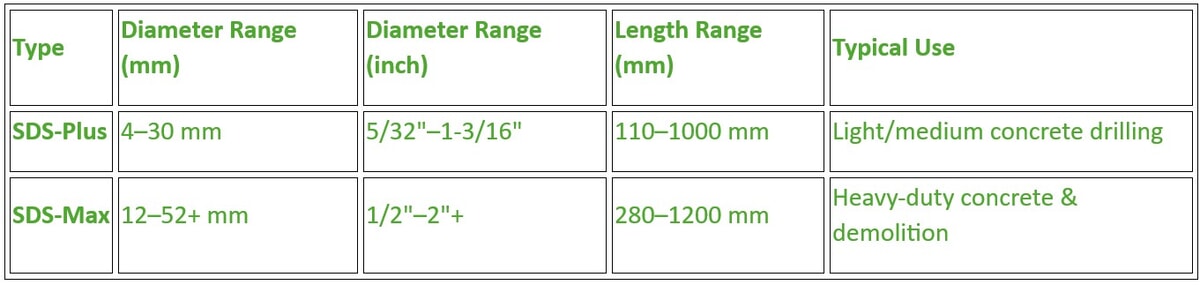
SDS Drill Bit Sizes by Region (USA / AU / NZ / EU)
Below is the real‑world size availability you’ll find in hardware stores and online retailers across these regions.
SDS‑Plus Sizes (Worldwide Standard)
Diameter Range (All Regions)
- 4 mm – 30 mm
- 5/32″ – 1‑3/16″
Commonly Stocked Sizes
- USA: 3/16″, 1/4″, 5/16″, 3/8″, 1/2″, 5/8″, 3/4″
- AU/NZ: 5 mm, 6 mm, 8 mm, 10 mm, 12 mm, 14 mm, 16 mm
- Europe: 4 mm, 5 mm, 6 mm, 8 mm, 10 mm, 12 mm, 14 mm, 16 mm, 20 mm
Length Range (All Regions)
- 110 mm – 1000 mm
- 4‑1/4″ – 39″
Notes
- Europe tends to stock the widest range (because SDS originated there).
- USA stores often stock imperial‑labeled equivalents, but the bits are still metric.
SDS‑Max Sizes (Worldwide Standard)
Diameter Range (All Regions)
- 12 mm – 52 mm+
- 1/2″ – 2″+
Some manufacturers offer:
- Up to 80 mm (3‑1/8″) for core bits
- Up to 150 mm (6″) for hollow core cutters
Commonly Stocked Sizes
- USA: 1/2″, 5/8″, 3/4″, 1″, 1‑1/4″, 1‑1/2″, 2″
- AU/NZ: 12 mm, 16 mm, 20 mm, 25 mm, 28 mm, 32 mm, 40 mm
- Europe: 12 mm, 14 mm, 16 mm, 18 mm, 20 mm, 25 mm, 28 mm, 32 mm, 40 mm, 52 mm
Length Range (All Regions)
- 280 mm – 1200 mm
- 11″ – 47″
Notes
- Europe again has the widest selection, especially for long bits.
- USA focuses more on heavy‑duty demolition sizes.
Countersink and Deburring Bits (Finishing Accessories)
- Diameter (Size): Head diameters typically range from 6 mm to 25 mm (1/4″ to 1″).
- Length: Very short.
- Hole Depth Match: Not designed for hole depth; strictly used for surface-level beveling and hole widening.
- Fit: Round or hex shanks.
- Drill Suitability: Corded and cordless rotary drills; drill presses are optimal.
- Material Suitability: Wood, plastics, and metals.
- Tough Materials: HSS handles standard metals; cobalt or carbide variants are required for stainless steel.
- Coating: Uncoated, black oxide, or TiN coated.
- Tip Type: Conical shape (single flute, cross-hole, or multi-flute) with angles matching standard screw heads (e.g., 82°, 90°).
- Cutting Speed: Very fast for shallow bevels.
- Hole Finish: Clean, smooth, beveled surface.
- Life: Long lifespan, as they do very little deep cutting.
- Sharpening: Cross-hole types can be sharpened with a small round file; multi-flute variants are difficult to sharpen.
- Lubrication: Cutting oil is needed when countersinking metal to achieve a smooth finish.
- Storage: Keep in protective cases to prevent nicks to the cutting edge, which will cause surface scratches on the workpiece.
- High-Speed Drilling Safety: Unsafe for high speeds. High RPMs induce “chatter” (vibration), leaving an ugly, wavy, polygon-shaped rim.
- Special Handling: Apply light, even pressure at low RPMs to achieve a chatter-free bevel.
- Sizes (Regional): Sized by the outer diameter and the degree of the angle (82° standard in USA; 90° common in metric regions).
- Standards Use: Angles standardized to match standard fastener head geometries (ASME/DIN).
Specialty Drill Bits (Common in Industry and MRO)
(Note: “Specialty” encompasses a vast range; the points below reflect common Glass/Tile and Screw Extractor MRO bits).
- Diameter (Size): Typically small, ranging from 3 mm to 12 mm (1/8″ to 1/2″).
- Length: Short.
- Hole Depth Match: Shallow holes through single substrates (e.g., a ceramic tile or pane of glass).
- Fit: Round or hex shanks.
- Drill Suitability: Corded or cordless rotary drills ONLY. Never use hammer action.
- Material Suitability: Ceramic, porcelain, glass, mirrors. Left-hand extractors are for broken steel bolts.
- Tough Materials: Diamond grit or specialized carbide spade tips handle extreme hardness (porcelain) but possess zero toughness (highly brittle).
- Coating: Diamond particle plating or specialized carbide braze.
- Tip Type: Spear-point (spade) carbide tip or hollow diamond-coated cylinder.
- Cutting Speed: Extremely slow. Grinds rather than cuts.
- Hole Finish: Clean, chip-free entry if used properly.
- Life: Very low lifespan. Diamond grit strips quickly; carbide spear points dull after a few porcelain tiles.
- Sharpening: Impossible to sharpen. Discard upon dulling.
- Lubrication: Continuous water or specialized coolant is absolutely mandatory to prevent thermal cracking of the glass/tile and destruction of the bit.
- Storage: Store in protective plastic tubes. The carbide spear points are highly brittle and will chip if dropped.
- High-Speed Drilling Safety: Highly unsafe. High speeds cause immediate thermal shock, shattering the workpiece and instantly burning off the cutting edge.
- Special Handling: Requires a steady hand, light pressure, and constant cooling. Often requires starting at a 45-degree angle to create a divot before moving perpendicular.
- Sizes (Regional): Standard metric and fractional fractional measurements.
- Standards Use: Proprietary manufacturing standards based on the specific industrial application.
FAQ – Frequently Asked Questions
1) What is the best “all-purpose” drill bit to keep in a basic kit?
For general maintenance across mixed materials, a 135° split-point HSS twist drill set is a practical baseline. It starts holes with less walking than a standard 118° point and works well on mild steel, aluminum, plastics, and wood (though it is not a substitute for specialty wood bits when tear-out matters).
2) When should a step drill bit be chosen instead of a standard twist drill?
Use a step drill bit for thin sheet metal and plastic – especially panels, enclosures, and electrical boxes because it enlarges holes gradually, reduces grabbing, and typically leaves a cleaner hole. For thicker metal, a twist drill (or a sequence of pilot + final size) is usually more effective.
3) What drill bit should be used for concrete: masonry bit or SDS bit?
- Use a standard masonry bit with a hammer drill for light to moderate concrete, brick, and block work.
- Use an SDS (SDS-Plus/SDS-Max) bit with a rotary hammer for faster drilling, deeper holes, and harder concrete common for anchors and frequent site work.
4) Why do drill bits go dull quickly or overheat in metal?
The most common reasons are:
- the wrong bit material (e.g., basic HSS on stainless without proper technique),
- excessive speed (RPM) causing heat,
- too little feed pressure leading to rubbing instead of cutting,
- poor chip clearing (chips trapped in flutes),
- drilling without lubricant when it would help (especially on tougher steels). Upgrading to cobalt HSS for stainless and controlling speed/feed typically improves life significantly.
5) How can drill bit inventory be simplified without hurting performance?
A practical approach is to standardize by application:
- Metal: split-point HSS set + a small cobalt set for tougher steels
- Wood: brad point set + spade or auger bits for larger/deeper holes
- Masonry: masonry bits for hammer drills + SDS bits for rotary hammers
- Sheet/panels: step drill bit(s) covering common sizes
This reduces “wrong-bit” usage, improves hole quality, and makes reordering easier.
Next Recommended Article : Common Power Tool Mistakes & How To Avoid Them
Further reading (3 references)
- ISO 235 – Twist drills – Jobber and stub series (dimensions)
- ISO 5468 – Hardmetal (carbide) tips for percussion drill bits – Requirements and test methods (relevant for masonry/hammer drilling performance expectations).
- ISO 8688 (series) – Tool life testing in milling
Editorial Disclaimer
This article is for educational purposes only, and readers should always refer to the manufacturer’s official specifications and safety guidelines for exact application requirements.