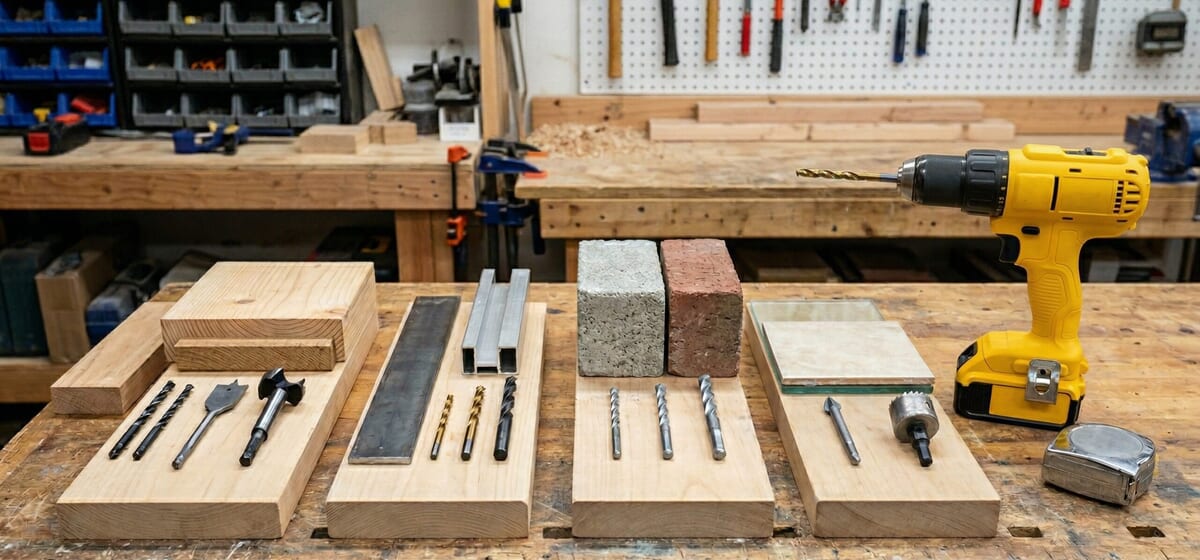
Choosing drill bits by material is one of the simplest ways to improve drilling speed, hole quality, and overall tool life without changing the drill itself. Across the USA, Australia, and New Zealand, many maintenance teams and trade crews carry a mixed assortment of bits and make the best of what is available on the day.
That approach works until it doesn’t: stainless overheats, aluminum loads up, masonry bits get used on steel, and wood tears out at the exit. The cost is not only broken accessories; it is labor time, rework, and inconsistent results.
From a procurement and tool supply viewpoint, the best drilling setups are predictable. The material is known (or at least likely), the hole sizes repeat, and the correct bit style is stocked in enough quantity.
Technical sales teams, machine manuals, and established workshop guidance tend to agree on a practical rule: match the bit’s cutting geometry and tool material to the workpiece, then apply reasonable speed, pressure, and chip control.
This article explains how to select drill bits by material in a straightforward way, with notes relevant to North American and Oceania job sites, supported by common European standardization practices and the realities of Asian manufacturing supply chains.
1) The three selection factors that matter most
Before getting into each material, drill bit choice can be simplified into three questions:
- What is the workpiece material and condition?
(Softwood vs hardwood, mild steel vs stainless, new aluminum vs oxidized plate, reinforced concrete vs brick.) - How thick is it and what hole quality is required?
(Thin sheet needs control; thick stock needs chip evacuation; visible woodwork needs clean edges.) - What drilling tool is being used?
(Cordless drill, drill press, mag drill, hammer drill, rotary hammer, CNC.)
Once those are clear, the correct bit type becomes obvious most of the time.
2) Choosing bits for wood (softwood, hardwood, plywood)
Best bit choices
- Brad point bits: best for clean entry and reduced wandering, especially in cabinetry and finish carpentry.
- Auger bits: best for deep holes in timber, beams, and structural wood; excellent chip evacuation.
- Spade (paddle) bits: fast for rough holes in framing and general construction.
- Forstner bits: best for flat-bottom holes (hinges, dowels) and clean overlapping holes.
Why wood needs “wood bits”
Wood tears because the fibers are pulled rather than cleanly severed. Bits designed for wood typically include spurs or rim cutters that score the perimeter first.
Practical tips
- For plywood and veneered panels, brad points often reduce chipping at the surface.
- To reduce exit tear-out, back up the workpiece or stop just before breakthrough and finish from the other side.
- Nail strikes are common in renovation work; keep separate “site bits” and “fine work bits” to avoid ruining premium sets.
3) Choosing bits for mild steel and general carbon steel
Best bit choices
- HSS twist drills (135° split point preferred for general maintenance): strong baseline for most shop and site steel drilling.
- Cobalt HSS (M35/M42): useful when heat is high, holes are numerous, or the steel is tougher than expected.
Why geometry matters
For steel, the priority is stable cutting and chip formation. A split point reduces walking and lowers thrust force, which is valuable with handheld drilling.
Practical tips (job site reality)
- If a bit is squealing and turning blue, it is usually rubbing (too fast, too little feed, dull bit, or no lubrication where needed).
- In maintenance environments, it is common to see mixed steels; keeping a small cobalt range for frequently used sizes prevents downtime.
4) Choosing bits for stainless steel (304/316 and similar)
Best bit choices
- Cobalt HSS twist drills (often 135° split point): common choice for handheld and drill press work.
- Carbide drills (solid carbide or carbide-tipped): best suited to rigid machines and controlled setups.
Why stainless is different
Stainless tends to work harden if rubbed. Once work hardened, drilling gets slower and heat rises quickly. The bit must cut decisively, not polish.
Practical tips
- Use controlled speed and firm feed so the bit cuts continuously.
- Use suitable cutting fluid where allowed.
- If repeated stainless drilling is part of the job in the USA/AU/NZ (food equipment maintenance, marine fabrication, architectural work), standardizing cobalt bits often improves both cost and reliability.
5) Choosing bits for aluminum and other non-ferrous metals
Best bit choices
- HSS twist drills with good chip evacuation and sharp edges: commonly effective.
- Bits marketed for aluminum (geometry optimized): helpful for reducing chip welding and loading.
- Step drill bits for thin aluminum sheet: excellent control and clean holes.
Common issue: loading (built-up edge)
Aluminum can stick to the cutting edge, especially if heat builds or chips are not clearing. Once loaded, the bit rubs and overheats.
Practical tips
- Use lubricant appropriate for aluminum (where permitted) to reduce sticking.
- Clear chips frequently in deeper holes.
- For panels and enclosures, step bits reduce grabbing and distortion.
6) Choosing bits for cast iron
Best bit choices
- HSS or cobalt twist drills often work well because cast iron is typically free-machining but abrasive.
- Carbide can be used in production or rigid setups.
What to expect
Cast iron produces powdery chips and is abrasive. Cutting fluids are sometimes avoided depending on shop practice and dust control, but follow site rules and safety policies.
Practical tips
- Dust management matters; cast iron debris can be messy and abrasive to moving parts.
- Inspect edges often; abrasion dulls bits faster than many expect.
7) Choosing bits for hardened steel and wear-resistant alloys
Best bit choices
- Carbide (rigid setups) or specialized hardened-material drills.
- In many field cases, drilling may not be the best approach; alternative methods may be required (such as carbide burrs, grinding, or EDM in industrial settings).
Practical reality
Many “mystery steels” in repair work are harder than expected. When standard bits fail repeatedly, the solution is usually not “more pressure,” but verifying hardness and changing method or tooling.
8) Choosing bits for plastics (acrylic, polycarbonate, PVC, nylon)
Best bit choices
- Sharp HSS twist drills can work well with proper technique.
- Step drill bits are excellent for thin plastics and reduce cracking.
- Specialty plastics drills (where available) reduce grabbing and improve hole quality.
Why plastics crack
Heat and stress concentration cause cracking, especially near edges. Aggressive feed or dull bits worsen the problem.
Practical tips
- Use moderate speed and controlled feed.
- Support the workpiece fully.
- For acrylic, avoid overheating; it can melt and grab.
9) Choosing bits for composites (fiberglass, carbon fiber)
Best bit choices
- Carbide and purpose-designed composite drills are common in production.
- For occasional work, high-quality sharp bits can work, but wear is rapid.
Key concern: abrasion and delamination
Composites can destroy cutting edges quickly and may delaminate if the bit geometry is unsuitable.
Practical tips
- Use backing support where possible.
- Expect faster tool wear; plan inventory accordingly.
- Dust control and PPE are critical; follow site safety requirements.
10) Choosing bits for masonry: brick, block, concrete, stone
Best bit choices
- Carbide-tipped masonry bits for hammer drills (lighter-duty).
- SDS-Plus / SDS-Max bits for rotary hammers (faster, heavier-duty).
- Diamond core bits for large holes, often with water management.
Why tool type matters
Using a standard masonry bit in a non-hammer drill is slow and overheats. Using the wrong shank system wastes energy and increases breakage.
Practical tips
- For anchor work in concrete, a rotary hammer with SDS bits often reduces labor time significantly.
- For reinforced concrete, use bits suited for that condition and follow local practices regarding rebar encounters.
11) Choosing bits for tile and glass
Best bit choices
- Spear-point carbide or diamond-coated tile/glass bits depending on tile hardness.
- For porcelain, diamond solutions are frequently used.
Practical tips
- Avoid hammer action on brittle materials unless the bit/system is designed for it.
- Control speed and cooling as recommended by the bit manufacturer.
12) Coatings and bit materials: what to specify (and what not to overvalue)
Common bit materials
- HSS: general purpose, good value.
- Cobalt HSS: better heat resistance; strong choice for stainless and tougher steels.
- Carbide: high wear resistance; best in rigid setups and abrasive materials.
Common coatings
- Black oxide: modest friction reduction and corrosion resistance.
- TiN: reduces friction; useful but not a cure-all.
- TiAlN/AlTiN: better at higher temperatures; often seen in industrial ranges.
Key procurement point: Coatings help, but correct geometry and correct base material matter more for most users.
13) Regional supply notes: USA, Australia, New Zealand, Europe, and Asia
- USA/AU/NZ: mixed trade and maintenance demand; many buyers need general-purpose sets plus a few premium “problem solvers” (cobalt for stainless, step bits for panels, SDS for concrete).
- Europe: strong emphasis on standardization and documented specifications; consistent geometry and shank standards are common in professional ranges.
- Asian manufacturing sector: extremely broad—ranging from entry-level consumables to high-end OEM production. Many premium brands source from Asia under strict quality control. The reliable approach is to verify specs, consistency, and supplier QA, rather than relying on country-of-origin assumptions.
14) A simple “by material” cheat sheet (quick selection)
- Softwood/Hardwood: brad point (clean), spade (fast), auger (deep), Forstner (flat-bottom)
- Mild steel: HSS twist drill, preferably 135° split point
- Stainless steel: cobalt HSS; carbide for rigid machines
- Aluminum sheet: step drill; aluminum-geometry twist drills
- Cast iron: HSS/cobalt; watch abrasion and dust
- Plastics: sharp twist drill or step drill; support the work
- Concrete/brick: masonry bit (hammer drill) or SDS (rotary hammer)
- Tile/glass: spear-point carbide or diamond bit
Additional valuable note: standardize kits by material category
A practical way to reduce accessory spend and improve outcomes is to build material-specific kits:
- Metal kit: split-point HSS + cobalt sizes used most often + countersink/deburr
- Wood kit: brad point + spade/auger + Forstner sizes required
- Masonry kit: masonry bits + SDS bits (if rotary hammers are used)
- Panel kit: step bits + hole saws + arbors and pilots
This approach fits procurement workflows well: it improves reorder accuracy, reduces wrong-bit usage, and makes training easier across crews and shifts.
Next Recommended Article :
Further reading
- ISO 235 – Twist drills – Jobber and stub series (dimensions) (useful for consistent purchasing and dimensional expectations).
- ISO 5468 – Hardmetal (carbide) tips for percussion drill bits – Requirements and test methods (relevant to masonry performance and quality).
- ISO 8688 (series) – Tool life testing in milling (helpful for understanding standardized tool-life evaluation concepts when comparing bit performance).
Drill Bit Types Explained Simply: A Practical Guide for Buying and Using the Right Bit
Editorial Disclaimer
This article is for educational purposes only, and readers should always refer to the manufacturer’s official specifications and safety guidelines for exact application requirements.