Fatigue and Tool Accidents
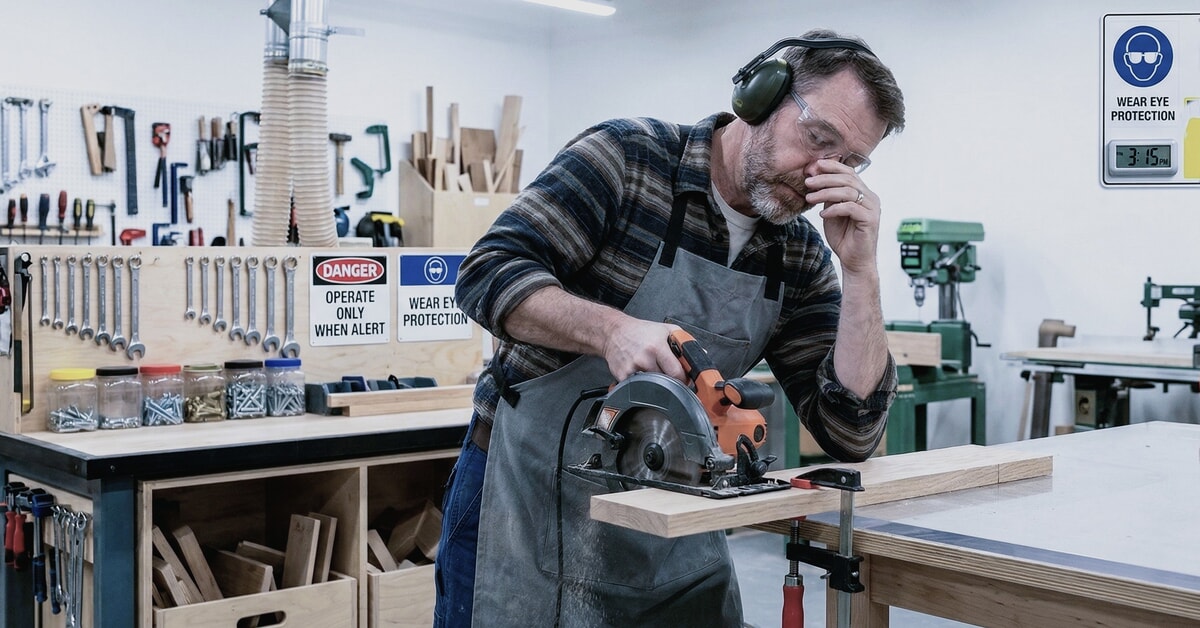
Fatigue and Tool Accidents are more closely linked than many workshops first realize. When a worker is tired, reaction time slows, concentration drops, judgment becomes weaker, and hand-eye coordination can suffer. Around power tools, that combination can turn a small mistake into a serious incident very quickly. That is why fatigue is not just a comfort issue. In tool use, it is a real safety issue.
In a power tools setting, fatigue does not always look dramatic. It can appear as repeated slips, poor grip, missed steps in setup, slower stopping response, wrong accessory selection, rushed cutting, or failure to notice vibration, overheating, kickback risk, damaged cords, or worn guards. These are ordinary workshop moments, but fatigue makes them more dangerous because tired people are less able to spot hazards early and respond well under pressure.
Why this topic really matters ?
This topic is needed because power tool safety is not only about guards, PPE, and electrical condition. It is also about whether the operator is fit to use the tool safely. OSHA’s fatigue materials explain that long hours and irregular shifts can increase the risk of injuries and accidents, while Safe Work Australia states that fatigue reduces the ability to work safely and can increase risk from other hazards through slower reaction times, reduced alertness, poorer coordination, impaired memory, and weaker judgment.
That matters even more in workplaces using grinders, drills, saws, impact tools, demolition tools, and other hand-held power equipment. OSHA’s hand and power tool guidance already requires attention to safe condition, correct use, proper PPE, and training. A tired operator is more likely to fail on all four points. In practical terms, fatigue often acts as the factor that turns an existing hazard into an actual accident.
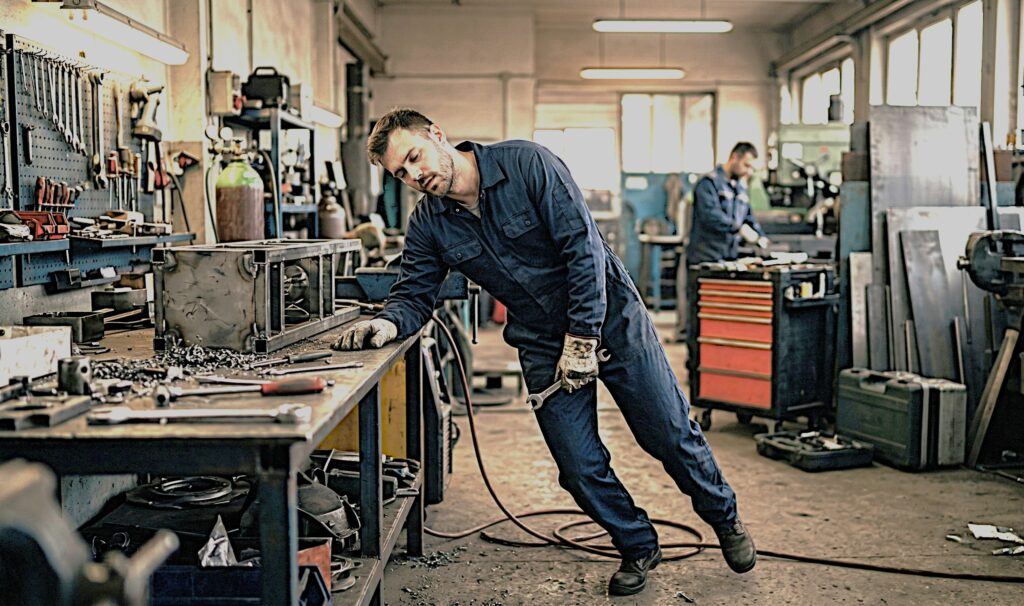
Is fatigue control mandatory or not?
The honest answer is: yes, managing fatigue is often effectively mandatory, but not always through one stand-alone rule called “fatigue and tool accidents.” In most places, fatigue is controlled through broader employer duties to provide safe work, safe systems, safe equipment, training, and risk management. So even where there is no single power-tool-specific fatigue law, employers can still have a legal duty to address fatigue if it creates a recognised risk.
In the United States, OSHA has direct standards for hand and power tools, and OSHA also publishes specific guidance on worker fatigue. OSHA says employers can reduce fatigue risk by examining workload, work hours, understaffing, absences, rest opportunities, and training. OSHA also notes that some federal agencies and states have laws restricting hours on the job, which shows that fatigue control can move from guidance into hard limits in some sectors.
In Australia, the position is even clearer. Safe Work Australia’s 2025 Model Code says a PCBU must ensure, so far as is reasonably practicable, that workers and others are not exposed to risks to their physical and psychological health and safety, including the risk of fatigue. It also says the PCBU must eliminate the risk if reasonably practicable, or otherwise minimise it so far as is reasonably practicable. That makes fatigue a direct WHS issue, not just a nice extra.
New Zealand takes a similar view. WorkSafe says fatigue is a potential risk and that PCBUs and workers have responsibilities to manage fatigue at work. Its quick guide recommends a workplace fatigue policy, reporting systems, investigation of incidents where fatigue may be involved, and fatigue training for new workers.
So the practical conclusion is simple: fatigue control may not always be a separate power tool law, but ignoring fatigue is not a safe or defensible position where tool use is involved.
How fatigue leads to tool accidents ?
Fatigue affects tool safety in several predictable ways. First, it reduces attention. A tired worker may miss loose handles, blunt accessories, poor cable routing, or an incorrect attachment. Second, it slows reaction time. If a grinder grabs, a drill binds, or a cut starts wandering, the tired operator may respond too late. Third, it weakens judgment. That can lead to “just one quick cut” thinking, skipping clamps, working one-handed, removing guards, or choosing the wrong speed. Fourth, fatigue lowers physical control. Reduced coordination, weaker grip, and poorer balance matter a great deal when holding vibrating or rotating tools.
Fatigue can also combine with other shop-floor risks. Heat, noise, dust, repetitive work, long standing, awkward posture, production pressure, night shifts, and understaffing all make things worse. Safe Work Australia and Singapore’s WSH guidance both describe fatigue as something influenced by workload, long hours, poor shift design, inadequate rest breaks, and the work environment. In real workshops, accidents often come from this combined pressure, not from one single failure.
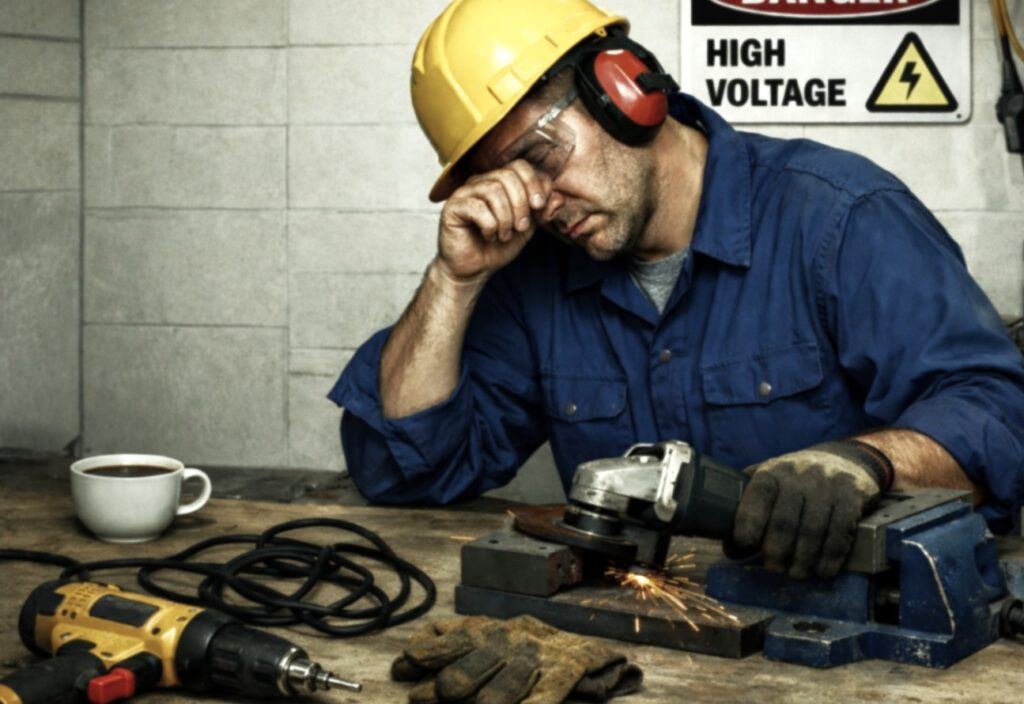
Signs that fatigue is starting to affect safe tool use:
A good supervisor or workshop owner should not wait for an injury before acting. Common warning signs include frequent yawning, low energy, forgetfulness, poor communication, bad decisions, slower reactions, reduced hand-eye coordination, irritability, sluggish movement, and repeated minor errors. WorkSafe New Zealand lists many of these symptoms directly, including poor decision-making, reduced hand-eye coordination, and slower reaction times.
On the job, that may show up as rework increasing late in the shift, more dropped tools, mis-cuts, unusual breakage, repeated near misses, or workers needing instructions repeated several times. These are not only productivity signals. They are safety signals too. Fatigue should be treated like any other hazard warning.
What good workplaces do about it?
The best approach is not to blame the worker. The better approach is to design work so the worker has a fair chance of staying alert and safe. OSHA recommends looking at staffing, workload, work hours, rest opportunities, the work environment, and education. Safe Work Australia adds practical controls such as consulting workers, scheduling sufficient breaks, reducing night-shift burden, rostering enough workers for expected workload, rotating demanding tasks, and ensuring the worker has the right training, skills, and experience.
For power tool operations, that usually means:
- matching difficult or high-risk cutting work to the most alert part of the shift.
- planning regular breaks before quality and attention collapse.
- rotating workers out of high-vibration, high-force, or repetitive tool tasks.
- stopping overtime from becoming the normal production model.
- checking tools, guards, cords, discs, bits, and accessories before use, not after a problem occurs
- training workers to report fatigue early without feeling punished for it.
- reviewing near misses for fatigue involvement instead of only blaming “operator carelessness”.
A fatigue policy does not need to be complicated to be effective. It can be as practical as setting maximum shift expectations, break rules, fit-for-work reporting, overtime approval limits, job rotation, and stop-work authority when someone is not alert enough to use powered equipment safely. The important point is that the policy must actually connect to day-to-day tool use, not sit unread in a file.
A useful line for workshop owners is this: “Do not judge fatigue only by hours worked. Judge it by hours worked, task difficulty, heat, noise, concentration demand, overtime pattern, and how safely the worker is still operating the tool.” That keeps the conversation practical and makes the article more valuable for real shop-floor readers.
Regional view: what this looks like in practice:
USA
In the USA, the legal structure is a combination of tool-specific OSHA standards and broader employer responsibility for recognised hazards. OSHA’s hand and power tool resources point to standards for general industry, construction, and other sectors, while OSHA’s fatigue materials explain that long hours and irregular shifts can increase injury risk and that employers should address staffing, schedules, rest, and training. For many shops, that means fatigue control is part of ordinary safety management rather than a separate named program only for large corporations.
Australia
Australia is moving with very clear language on fatigue. Safe Work Australia’s model code treats fatigue as a WHS risk that must be eliminated or minimized so far as reasonably practicable. It also stresses consultation with workers and other duty holders, plus practical controls such as breaks, workload planning, worker numbers, and reducing fatigue-related errors. For workshops using power tools, this is a strong signal that fatigue belongs inside the formal risk assessment process.
New Zealand
New Zealand’s WorkSafe guidance is practical and business-friendly. It says fatigue reduces the ability to perform work safely and effectively, and it recommends a fatigue policy, reporting pathways, incident investigation, and training. For smaller workshops, this is important because it shows fatigue management is not only for mines, transport fleets, or large factories. It also applies where everyday powered equipment can still cause serious harm.
Europe
Europe supports the same broad principle through both working-time protection and equipment ergonomics. The European Commission’s Working Time Directive framework includes an average weekly limit of 48 hours including overtime, at least 11 consecutive hours of daily rest, a break when the workday is longer than 6 hours, and extra protection for night work, including a limit of 8 hours in any 24-hour period for heavy or dangerous night work. In addition, European machinery and work equipment rules give weight to ergonomics and reducing fatigue or physical and mental stress.
Asian manufacturing sector
Across the Asian manufacturing context, the pattern is often broader fatigue and working-time control rather than one dedicated hand-tool fatigue law. Singapore’s WSH guidance says fatigue from long hours, poor shift planning, and poor breaks can damage alertness, concentration, judgment, motor skills, and reflexes, and it states that there are no national fatigue standards, so the guidance is intended to help industries manage the risk. Japan’s labour guidance, meanwhile, emphasises compliance with working hours and workplace safety through labour standards oversight. Taken together, the practical lesson for Asian manufacturing is clear: the issue is recognised, and the safer factories treat fatigue as a production-planning and worker-protection issue, not merely as a personal weakness.
Final takeaway
Fatigue and tool accidents should be taken seriously because tired workers are less able to use power tools safely, spot hazards early, and react correctly when something starts to go wrong. Is this really needed? Yes. Is it always mandatory as a separate named rule? Not everywhere. But in real compliance terms, fatigue is often covered through wider duties to provide safe work, safe equipment, safe systems, training, and proper risk control. For any workshop that uses power tools regularly, fatigue management is not overthinking. It is part of doing the job properly.
Frequently Asked Questions : FAQ: Fatigue and Tool Accidents :
-
What are fatigue and tool accidents?
Fatigue and tool accidents refer to incidents that happen when a tired operator uses a power tool with reduced alertness, slower reaction time, weaker judgment, or poor coordination. In a workshop, fatigue can increase the chance of slips, wrong tool handling, missed safety steps, and serious injury.
-
Is fatigue really a safety issue when using power tools?
Yes. Fatigue is a real safety issue in power tool work because tired operators may not notice hazards early enough or react fast enough when something goes wrong. Even a small delay in judgment or control can increase the risk of cuts, kickback, tool drops, or incorrect operation.
-
Are employers required to manage fatigue at work?
In many workplaces, yes. Even where there is not one separate law called “fatigue and tool accidents,” employers are usually expected to manage known risks under general workplace health and safety duties. That means fatigue may need to be controlled if it could affect safe tool use.
-
Is fatigue management mandatory in the USA, Australia, and New Zealand?
The exact rules differ, but the general answer is yes in practice. In the USA, fatigue is often handled through broader safety responsibilities and safe work expectations. In Australia and New Zealand, fatigue is more clearly treated as a workplace risk that should be identified and managed as part of normal safety systems.
-
How does fatigue increase the chance of tool accidents?
Fatigue can reduce concentration, slow reaction time, weaken grip, affect balance, and lead to poor decisions. A tired worker may choose the wrong accessory, skip a safety check, rush a cut, or respond too slowly during a tool jam or kickback event.
-
What are common signs of fatigue in a workshop?
Common signs include yawning, slow reactions, forgetfulness, repeated small mistakes, loss of focus, irritability, poor coordination, and reduced communication. In tool work, it may also appear as more rework, more near misses, or declining work quality late in the shift.
-
Can a skilled operator still have a fatigue-related accident?
Yes. Skill helps, but fatigue can affect even experienced workers. Long hours, heat, repetitive work, noise, vibration, and poor rest can reduce performance regardless of experience level.
-
What are simple ways to reduce fatigue and tool accidents?
Practical steps include planning sensible shifts, allowing regular breaks, rotating demanding tasks, avoiding excessive overtime, checking tools before use, and encouraging workers to report fatigue early. Good supervision and realistic production targets also help reduce risk.
-
Does fatigue matter more in manufacturing and industrial work?
Yes, especially where workers use grinders, drills, saws, impact tools, and other powered equipment for long periods. In industrial settings, fatigue can build up from repetitive work, shift schedules, production pressure, heat, and vibration.
-
Is fatigue only caused by long working hours?
No. Long hours are one cause, but fatigue can also come from poor sleep, night shifts, repetitive tasks, heavy physical effort, mental pressure, heat, noise, and insufficient recovery time between shifts.
Next Recommended Article : The Metalworker’s Arsenal: 7 Power Tools That Define Modern Fabrication.
Further reading
- OSHA – Long Work Hours, Extended or Irregular Shifts, and Worker Fatigue.
- Safe Work Australia – Model Code of Practice: Managing the risk of fatigue at work.
- WorkSafe New Zealand – Fatigue quick guide.
Understanding Machine Downtime Cost: A Step-by-Step Guide to Fixing Delays and Saving Margins
Editorial Disclaimer
This content is for educational purposes only. Always follow manufacturer guidance and safety procedures.