
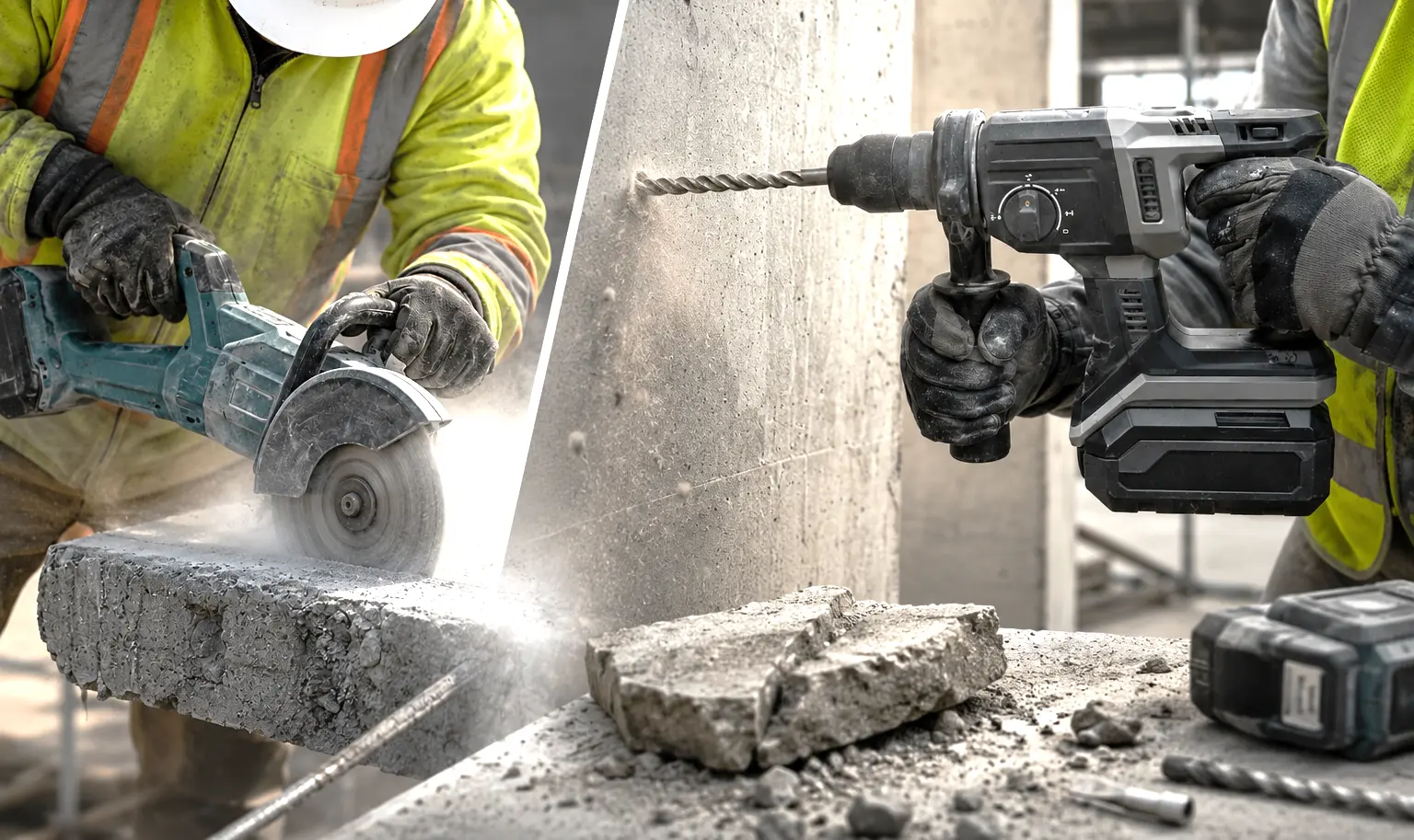
Choosing tools for concrete drilling and cutting is one of those decisions that looks simple until the job begins. Concrete changes from site to site. A new slab may drill quickly, while an older section with hard aggregate and dense reinforcement can stall tools and consume accessories.
Dust rules vary between locations and industries, and the difference between “a few anchor holes” and “a full day of penetrations” is the difference between acceptable and costly downtime. Across the USA, Australia, and New Zealand, cordless tools are increasingly expected to perform concrete work that used to be reserved for corded equipment, which makes tool selection, battery planning, and accessory choice more important than ever.
Manufacturers’ manuals, jobsite safety guidance, and engineering literature consistently point to the same fundamentals: the most productive setup is the one that matches the tool’s impact mechanism and power to the concrete task while controlling dust and heat. European job sites often show stronger standardization around dust extraction and compliance-driven accessory selection. Asian manufacturing influences the market through large-scale production of diamond abrasives, carbide bits, and battery cells, meaning quality and consistency depend heavily on specification control and reputable supply chains. The goal for buyers and crews is to select tools that produce reliable results, not just tools that “can do the job once.”
This article explains how to choose cordless tools for drilling and cutting concrete : with a focus on practical site conditions and repeatable procurement decisions.
Understanding the concrete task before selecting the tool
Concrete work begins with a few questions that strongly influence tool choice. The first is whether the task is drilling, cutting, or both. Drilling for anchors and fasteners needs a tool that can repeatedly fracture mineral material efficiently, while cutting needs a tool that manages abrasion and heat without binding. The second question is hole or cut size and depth.
Small anchor holes behave differently than large-diameter penetrations. The third is the risk of reinforcement, because hitting rebar changes the tool and accessory requirements immediately. The final factor is dust management, which is not optional in many modern work environments and often drives the whole system selection.
When these conditions are known, the best cordless solution becomes clearer, and the selection can be standardized for crews across multiple sites.
Choosing cordless tools for concrete drilling
Concrete drilling typically falls into three tool categories: cordless hammer drills, cordless SDS rotary hammers, and specialized coring systems. The correct choice depends on volume of holes, diameter, depth, and hardness of the slab.
A cordless hammer drill is commonly used for light anchor drilling in masonry and softer concrete, especially when the crew already carries the tool for general work. These drills use a mechanical hammering action intended to chip away the material while the bit rotates. In practice, they work best for smaller diameter holes and limited quantities.
For a few anchors in block or a simple bracket installation, a hammer drill can be adequate and cost-effective. Problems begin when hole counts rise, holes get larger, or concrete becomes dense. The tool slows down, batteries drain quickly, and the operator often compensates with pressure, which increases heat and fatigue.
A cordless SDS rotary hammer is the main workhorse for concrete drilling. Rotary hammers use a piston mechanism to deliver hammer energy more efficiently than a standard hammer drill. That efficiency is the difference between “drilling works” and “drilling is productive.” For crews in the USA, Australia, and New Zealand who frequently install anchors, drill for services, or perform regular maintenance on concrete infrastructure, a cordless SDS-Plus rotary hammer is often the most practical baseline because it balances capability, portability, and accessory availability.
SDS-Max systems are typically chosen when hole sizes are larger or when drilling is frequent and heavy-duty, but they come with larger tools and more expensive bits. The decision should be based on the highest-demand recurring tasks, not the occasional extreme case.
Concrete drilling also depends heavily on accessories. SDS masonry bits vary in head design, carbide grade, and flute geometry. Better bits clear dust more effectively, drill straighter, and run cooler. In procurement terms, a high-quality bit that drills faster often reduces total cost because labor and battery consumption fall. This is where European-style standardization helps: specifying bit type and quality level for common anchor sizes makes field performance more predictable.
Rebar considerations change the approach. Standard carbide masonry bits can be damaged by repeated rebar strikes. On sites where reinforcement is likely, it is common to plan for rebar-capable bits or to use scanning practices to reduce hits.
When rebar is encountered, crews often switch to a metal drilling method or rebar-specific solution depending on the system and local practice. The important point is not to assume “all concrete holes are the same.” Reinforcement risk should be part of the tool and accessory plan.
Dust extraction is another key drilling factor. Efficient drilling requires the hole to clear dust. Dust also creates health and cleanup problems, and regulations and site rules increasingly require control measures. Many manufacturers offer dedicated extraction attachments that mount to the tool, along with compatible vacuums and filters.
A rotary hammer drilling system that includes dust extraction typically drills more consistently because the bit is not constantly regrinding loose dust in the hole. This is one reason European job sites often appear faster and cleaner on comparable drilling tasks. The same benefit is achievable anywhere when the drilling system is treated as tool plus extraction, not just tool alone.
Battery and runtime planning should not be underestimated. Concrete drilling is a high-load task, and smaller battery packs can overheat or drop voltage under sustained work.
Many tool ecosystems deliver better performance with higher-capacity packs, not only because runtime increases but because the pack can deliver current with less stress. For fleet buyers, the right approach is to match battery capacity to the expected duty cycle rather than issuing a single battery size for every tool.
Choosing cordless tools for concrete cutting
Concrete cutting includes trimming, scoring, opening up channels, cutting pavers, and making access cuts. The main cordless tools used are angle grinders with diamond blades, dedicated cut-off saws, and in some cases rotary tools or specialty saw systems depending on the application.
Cordless angle grinders are often the first choice for smaller concrete cutting and finishing tasks because they are common on job sites and versatile. With the correct diamond blade, a grinder can score and cut concrete, masonry, and stone.
The limitation is depth and control. Grinders are usually best for shallow cuts, edge trimming, and surface work rather than deep straight cuts across slabs. Cutting concrete with a grinder also generates significant dust and requires the correct guard and extraction setup to be both safe and efficient.
Dedicated cordless cut-off saws, sometimes called power cutters, are more appropriate when deeper cuts and straight lines are required. These tools provide better depth capacity and often better ergonomics for cutting. They also place higher demand on batteries and blades. Where cutting is frequent, the saw’s productivity can justify the higher cost.
Cordless vs. Corded Tools: What Small Contractors Should Know
In procurement and site planning, the decision often comes down to whether concrete cutting is a core task or an occasional requirement. If the work is occasional, a grinder-based approach with high-quality diamond blades may be enough. If cutting is frequent, a cut-off saw system with a consistent blade spec and dust control is usually more cost-effective.
Diamond blades are a major part of cutting performance. Blade selection depends on whether the concrete is green or cured, whether it includes hard aggregate, and whether it is reinforced. Segment design and bond hardness determine how fast the blade cuts and how long it lasts. A blade that is too hard for the material can glaze and stop cutting effectively.
A blade that is too soft can wear quickly. This is where knowledge from technical sales teams and manufacturer charts is genuinely useful. Many high-performing blades are produced in Asia under strict quality systems, and many reputable global brands source there; the key is consistent bond specification and reliable manufacturing quality.
Wet cutting versus dry cutting is another major decision. Wet cutting reduces dust and can improve blade life, but it requires water supply management and slurry control.
Dry cutting is more convenient on many sites but demands effective dust extraction and careful attention to overheating. Cordless tools often push users toward dry cutting because water management is not always available, which makes dust extraction and blade selection even more important.
Matching the tool to the job: typical site scenarios
For anchor installation and general site drilling, a cordless SDS-Plus rotary hammer with dust extraction support is usually the most practical core tool. It drills faster, reduces operator fatigue, and supports consistent hole quality for anchors.
A hammer drill can still be kept for light-duty and mixed-material work, but it should not be expected to replace an SDS system when drilling volume increases.
For light cutting, trimming, and scoring, a cordless angle grinder with a quality diamond blade and appropriate guard and extraction is a common and cost-effective setup. For deeper cuts, a dedicated cordless cut-off saw becomes the better option, especially when the work repeats across projects.
Why training and standardization matter as much as the tool
Many tool failures and poor results are not caused by the tool’s power rating but by incorrect system use. Concrete drilling and cutting reward consistent technique: letting the tool do the work, keeping accessories suited to the material, and avoiding overheating. From a procurement point of view, standardization reduces misuse.
If crews are provided with a clear drilling kit, a clear cutting kit, and the correct accessories stocked at the right quantities, performance becomes repeatable.
European job sites often show the benefit of this approach through tighter control of dust systems, accessory specifications, and replacement schedules. The same discipline works well in the USA, Australia, and New Zealand, where mixed crews and varied site conditions otherwise lead to improvised methods.
Additional valuable note: treat dust control as part of productivity, not only compliance
Dust extraction is frequently discussed as a safety requirement, but it also affects speed and tool life. A clean drilling hole reduces regrinding, and a cleaner cut line reduces friction. Tools run cooler, batteries last longer, and accessories wear more evenly. When comparing systems, it is often more accurate to compare “tool + accessory + dust solution” rather than the tool alone.
If typical hole diameters, daily hole counts, and cutting depth needs are shared, a practical cordless “concrete kit” can be specified with recommended SDS class (Plus vs Max), battery capacity guidance, dust extraction approach, and an accessory list that fits USA, Australia, and New Zealand site realities.
Further reading (international standards references)
- ISO 12100 : Safety of machinery : General principles for design : Risk assessment and risk reduction.
- ISO 11148 (series) : Hand-held non-electric power tools : Safety requirements.
- ISO 45001 : Occupational health and safety management systems.
RPM vs Cutting Speed in Power Tools: Why It Matters More Than You Think
Drill Bit Types Explained Simply: A Practical Guide for Buying and Using the Right Bit